



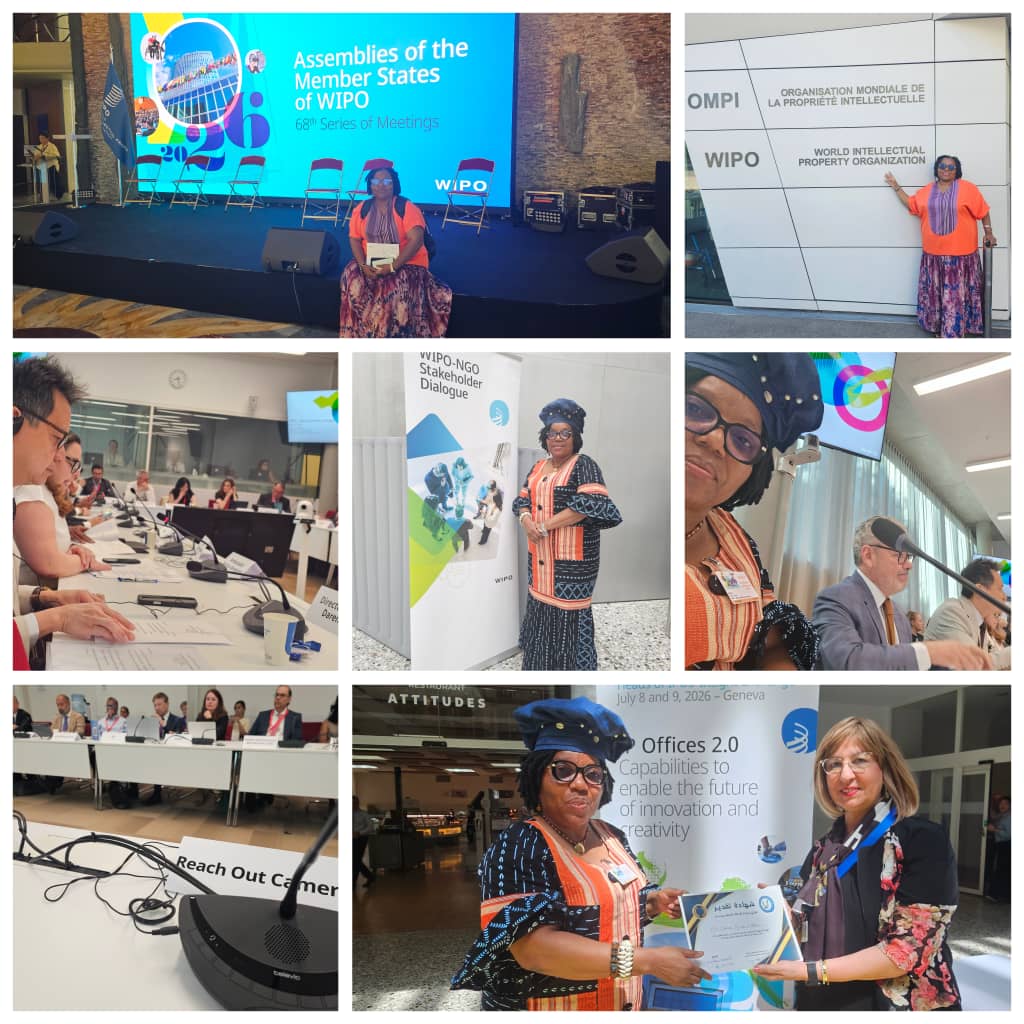
Dr. Omam Esther, Executive Director of Reach Out Cameroon (ROC) and Country Chair of the G100 Mentoring & Motivation Wing in Cameroon, has called for more inclusive intellectual property (IP) systems that recognize, protect, and reward grassroots innovation, particularly in fragile and conflict-affected communities.
Speaking during the World Intellectual Property Organization (WIPO) NGO Stakeholder Dialogue in Geneva, Dr. Omam Esther emphasized that communities facing conflict, displacement, and humanitarian crises continue to develop practical solutions that help them survive, adapt, and rebuild their livelihoods. Despite their ingenuity, she noted that many of these locally developed innovations remain undocumented, unprotected, and unrewarded, even when they are later adopted on a wider scale.
Drawing on nearly three decades of humanitarian action and peacebuilding through Reach Out Cameroon, an organization that has impacted more than 2.845 million beneficiaries, Dr. Omam Esther stressed that intellectual property should not only protect inventions and ideas but also safeguard the rights, ownership, and economic interests of the people behind those innovations.
She argued that strengthening intellectual property systems to include grassroots innovators would encourage creativity, promote inclusive economic growth, and empower women, young people, and local entrepreneurs to transform their communities.
“Communities living in fragile settings are constantly innovating to solve everyday challenges. These innovations deserve recognition and protection because they represent resilience, creativity, and hope,” she said during the dialogue.
Responding to her intervention, WIPO Director General Daren Tang reaffirmed the organization’s commitment to making intellectual property more accessible to grassroots innovators. He highlighted WIPO’s mentoring and capacity-building programmes designed to help entrepreneurs understand and benefit from intellectual property rights.
Tang pointed to successful initiatives in Cameroon and Zimbabwe that have supported women entrepreneurs in developing trademarks, branding strategies, and intellectual property management skills. He also revealed that WIPO has trained more than 200,000 participants worldwide through its intellectual property capacity-building programmes over the past six years, demonstrating the organization’s growing investment in innovation-driven development.
On the sidelines of the dialogue, Dr. Omam Esther was presented with a Certificate of Appreciation by the Egyptian Council for Innovation, Creativity & Protection of Information (ECCIPP). The award recognized her outstanding contributions to advancing innovation, promoting sustainable entrepreneurship, and empowering women as agents of peace and development.
Reflecting on the discussions in Geneva, Dr. Omam Esther reaffirmed her commitment to building stronger partnerships that will enable grassroots communities—particularly those affected by conflict—to protect their innovations, benefit from their creativity, and contribute meaningfully to sustainable development and lasting peace.
“Innovation flourishes even in the most fragile settings. Our responsibility is to ensure that those who create solutions are recognized, protected, and empowered to benefit from them,” she said.
Dr. Omam Esther holds a PhD in Diplomacy and Conflict Management and serves as Executive Director of Reach Out Cameroon, Country Chair of the G100 Mentoring & Motivation Wing Cameroon, Vice Chair of the Continental Network of Women Business Associations in Africa (CONWOBAA), and a Global Peace Champion. Her participation at the WIPO NGO Stakeholder Dialogue reinforced the growing call for intellectual property systems that are more inclusive and responsive to the realities of grassroots innovators across Africa and other fragile regions.
Fabris KEHDINGA
