



From a modest beginning in 2019 to an ambitious vision for 2035, STEM Higher Institute of Health and Technological Sciences is seeking to transform professional education through practical training, research and innovation.
By Betrand Ntumnyuy | November 2026
As Cameroon continues to grapple with graduate unemployment, skills gaps and concerns about the quality of professional training, the need for a more practical and innovative approach to higher education has become increasingly urgent.
For Dr. Meh Basil Kum, founder of STEM Higher Institute of Health and Technological Sciences (STEM-HIHTS), education must go beyond awarding certificates. It should produce competent professionals, innovators and entrepreneurs capable of solving societal problems and creating employment.

Established in 2019 as STEM Higher Institute of Health and Business, the institution began with more than 50 students during the 2019–2020 academic year. Today, it reports operating four campuses in Douala, reflecting its ambition to become a recognised player in Cameroon’s professional education sector.
A vision beyond the classroom
Dr. Meh Basil Kum, a physiotherapist, physiologist, researcher and education entrepreneur, founded STEM-HIHTS with a philosophy centred on practical learning, leadership, entrepreneurship and innovation.
His educational vision is also captured in his 2021 autobiographical book, I Am Victory: The Power of the Mind, which promotes the idea that education should prepare young people not only to seek employment but also to create opportunities and wealth.

Having obtained bachelor’s and master’s degrees in biomedical sciences, specialising in physiotherapy at the University of Dschang, he later earned a PhD in physiology from the University of Buea, publicly defending his thesis in March 2025.
His ambition is to contribute to making Cameroon an attractive destination for professional education and innovation in Africa by 2035.
Strengthening academic partnerships and research
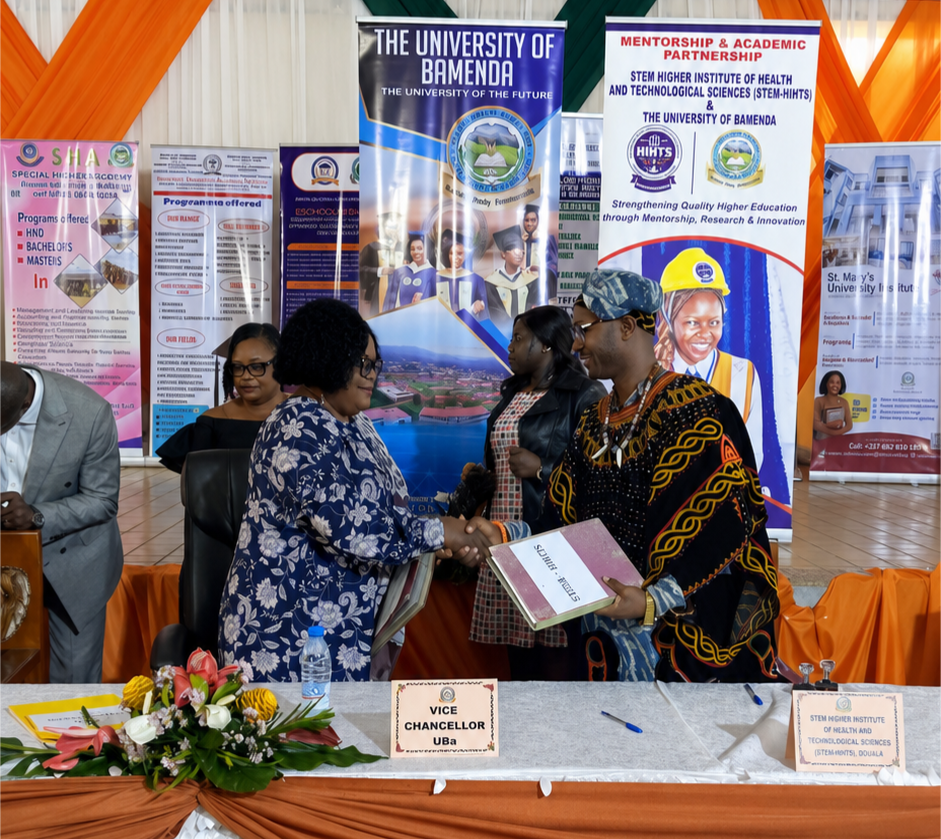
An important milestone in the institution’s development came in July 2026, when STEM-HIHTS and the University of Bamenda concretised their existing partnership through the signing of a renewed academic mentorship agreement.
The arrangement reinforces academic supervision and mentorship, providing an important framework for strengthening the quality of training.
The institute also reports attracting students from other African countries, including more than 100 Nigerians and approximately 15 students from Chad plus Sudan, Mali and other African countries.
Beyond academic training, research is becoming another important aspect of its development.
Dr. Meh, who publishes under the name Basil Kum Meh, has produced research covering public health challenges, including work-related musculoskeletal disorders, low back pain, obesity, traumatic brain injury and adolescent reproductive health.
A notable 2023 study involving 561 healthcare workers in Douala reported an 83.4 per cent prevalence of work-related musculoskeletal disorders.

Significantly, some of STEM-HIHTS’s 2026 research publications include student co-authors, suggesting growing opportunities for students to participate in scientific research while developing critical thinking and problem-solving skills.
Can private higher education change Cameroon?
Cameroon has hundreds of authorised private higher education institutions. However, increasing enrolment and institutional expansion alone cannot solve the challenges of graduate unemployment and inadequate professional skills.
What matters is the quality of graduates and their ability to translate academic knowledge into practical results.
STEM-HIHTS is pursuing this through practical and simulation-based training, research, entrepreneurship and academic partnerships. Its approach could contribute to improving professional education, particularly in the health sector.
Nevertheless, its long-term credibility will depend on measurable outcomes, including graduate employment, professional placements, research achievements, qualified teaching personnel and independently assessed academic standards.
The road to 2035
Dr. Meh Basil Kum’s ambition to position Cameroon as a destination for professional education and innovation in Africa by 2035 is bold. Achieving it will require internationally competitive programmes, modern facilities, stronger partnerships and graduates equipped to meet professional standards.

Seven years after its establishment, STEM-HIHTS presents an ambitious effort to rethink the relationship between education, research and employment.
Through his book, academic journey and the institution he founded, Dr. Meh is advancing a simple but important message: education should produce problem-solvers and opportunity creators, not just certificate holders.
Can he help redefine private higher education in Cameroon?
The answer will ultimately depend on the quality of professionals STEM-HIHTS produces and the measurable impact of its training and research.
But its journey presents an opportunity worth watching as Cameroon searches for a more relevant, practical and innovative higher education system.

The true measure of this vision will not be the number of campuses or students, but the number of competent professionals, researchers and job creators it produces for Cameroon and Africa.
